Dating is a Cognitive Error
I have a bad habit of trying to intellectualize my feelings. When I’m sad, I don’t want a hug, I want a peer-reviewed study explaining why I’m sad. Haha. Alas, the eternal question: Why are we the way we are? Why is it so hard to walk away from a "meh" situation? Why does having 1,000 options actually make us feel more alone? Why oh whyyyyy????
While researching cognitive biases for my last post, I realized that our (sorry for speaking on your behalf) disastrous dating patterns aren't bad luck. They are very much explainable by behavioral economics. It turns out that there are specific names for the ways our brains short-circuit in romance. Are we just rational actors trapped in an irrational system?
I’ve organized the result of my research into four systems (and I will later reference System 1 and 2 from Daniel Kahneman, so please don’t get confused!). I hope you enjoy this read.
System 1: The paralysis that comes from having multiple options
Put a finger down if you’ve ever unintentionally treated people on Hinge or Bumble like disposable commodities. I have. But why? Logically, more options should mean a higher probability of finding a perfect match. But psychologist Barry Schwartz argues that we are suffering from The Paradox of Choice. When we have 500 matches, the anxiety of picking just one paralyzes us. We always wonder… what if there’s someone better for me out there? Bring in Opportunity Cost Neglect. When we are sitting across from a perfectly nice 8/10 date, our brain isn’t enjoying the coffee. It is calculating the cost of being there. We think, “If I settle for this person, I am giving up the possibility of the theoretical 10/10 who is just one swipe away.” So we keep swiping, and swiping, and swiping, and swiping…
And that, ladies and gentlemen, is how we end up devaluing the human in front of us. Even if we DO pick someone, lo and behold, the Hedonic Treadmill (Brickman & Campbell, 1971) comes in, which highlights how we are wired to adapt to new sources of happiness quickly. The dopamine hit of a new match wears off almost instantly, and we return to our baseline. We end up in a cycle of chronic dissatisfaction where we are convinced that the real deal is still out there, unaware that our brain is chemically incapable of staying excited about ANYONE if we keep treating them like inventory. Yup. Sorry for calling you out. But wait, it gets worse.
It turns out, not everyone suffers from this equally. In the 1950s, economist Herbert Simon distinguished between two types of decision-makers: Maximizers and Satisficers.
Satisficers have a criteria list. Once they find someone who meets the criteria, they stop looking and are generally happy.
Maximizers need to know that they have made the absolute best possible choice. They can’t just find a good-enough partner, they need to survey the entire market to ensure a better one doesn't exist.
The research shows that while Maximizers often make “objectively” better decisions (so they might find someone with a better job or better looks, etc. etc.), they feel worse about their lives. Why? Because the Maximizer is haunted by the counterfactuals. The opportunity cost. The potential. Apps like bumble feed the Maximizer’s delusion that the “best match” is a solvable equation and not just a leap of faith.
System 2: Why the first date is either really good or really bad
So, we overcome the paralysis and go on the date. This is where we start hallucinating.
Scenario A: They walk in, they are gorgeous, and they are nice to the waiter. Immediately, the brain decides they are also smart, funny, good with money, and emotionally available. This is The Halo Effect (Thorndike, 1920). Because they have one positive trait, the brain assumes they have all the positive traits. (Oh my God, I actually fall for this so often. It’s so easy to see the good in people and let it turn into rose-tinted glasses. I often need my friends to keep my feet on the ground.)
Scenario B: They chew loudly. Suddenly, you decide that they are an irredeemable monster. This is the Horn Effect.
In both cases, we aren't seeing the person. We are seeing a projection. And what’s driving this car is Confirmation Bias. Once I decide you are perfect (Halo) or you are THE ICK (Horn), my brain stops observing and starts litigating.
If I like you: I ignore the red flags to confirm my belief that you are The One.
If I don't like you: I ignore your kindness to confirm my belief that I should go home and watch Netflix and swipe away.
System 3: The toxic attachment cycle or why we stay when we know we should leave.
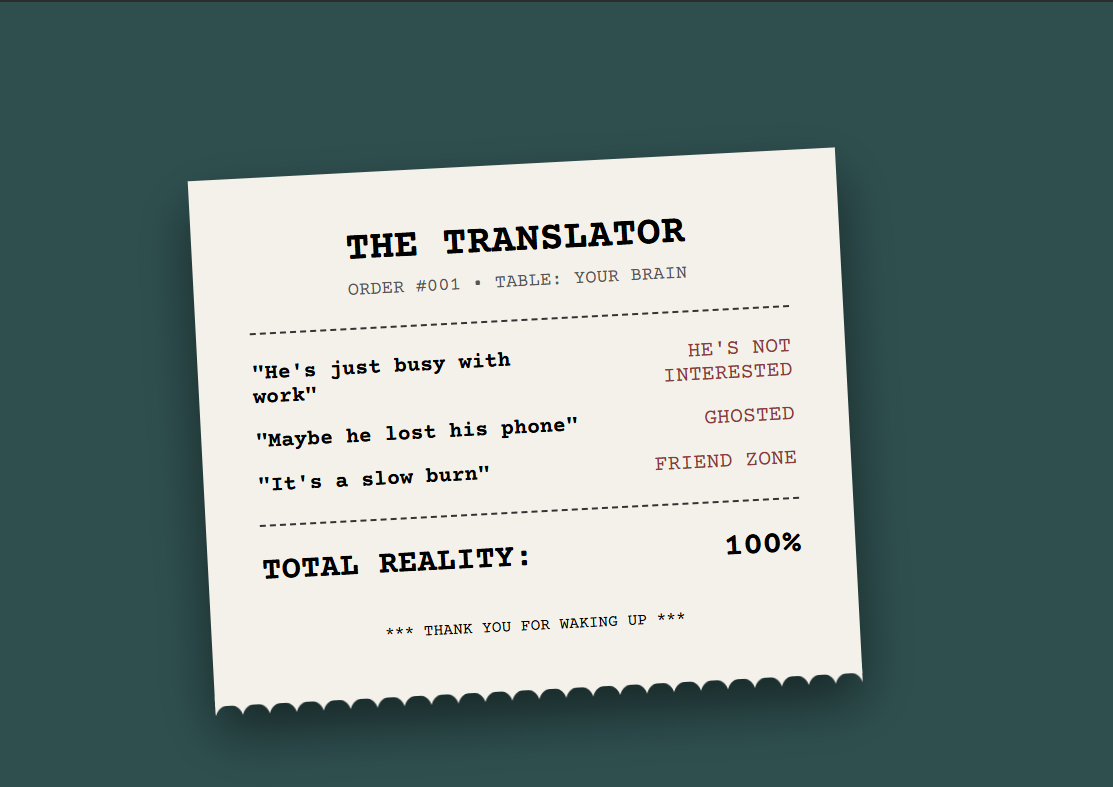
This is the one that hurts the most I suppose. I’ve seen many of my friends be scalded because they dated someone inconsistent. Those people are hot, then they are cold. They text back instantly on Tuesday but then take a week to reply. So why do we stay?
Firstly because we are rats in a cage. Yessir, we are. Seriously. B.F. Skinner found that if you give a rat a reward every time it presses a lever, it gets bored. But if you give the reward randomly (Intermittent Reinforcement), the rat becomes obsessed. It will press the lever until it starves. So… when a partner "breadcrumbs" us, they are putting us on a variable reward schedule. We inadvertently become addicted to the anxiety of the chase.
Secondly, we are bad economists. Boo… We fall for the Sunk Cost Fallacy. We think, "I’ve already put six months into this situationship. If I leave now, that time was wasted". (Spoiler: The time is gone whether you stay or leave. Staying just ensures you waste the NEXT six months too.)
There is a third, sneakier economic principle keeping us stuck here: The Endowment Effect. In a famous experiment, Daniel Kahneman gave half a class a coffee mug and the other half nothing. He asked the mug-owners how much they’d sell it for, and the non-owners how much they’d buy it for. The owners consistently asked for a price twice as high as the buyers were willing to pay. Why? Simply because owning something makes us overvalue it.
In dating, this is the IKEA Effect of love. Because we have invested effort into this person, because we listened to their childhood trauma and helped them pick their outfits and analyzed their internships, we value them significantly higher than the market does. Our friends (the buyers) look at our partner and see a 20HKD mug. We (the owners) look at them and see a 1000HKD heirloom. In other words, we aren't staying because they are a catch, we are staying because they are… ours.
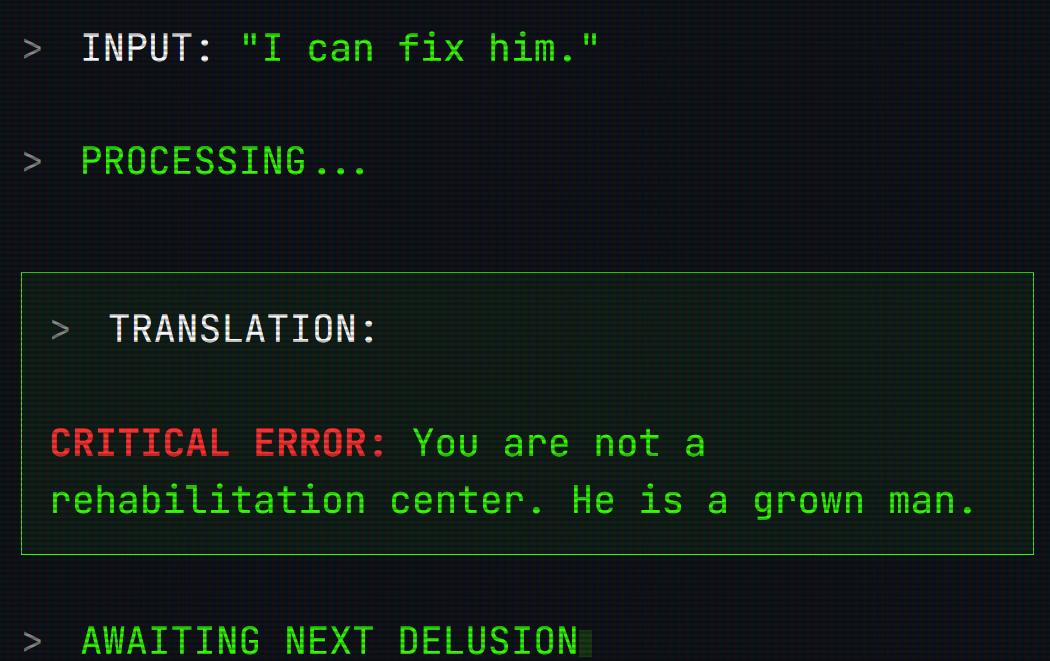
Finally, Loss Aversion (my favorite theory) kicks in. Kahneman and Tversky proved that the pain of losing something is twice as powerful as the pleasure of gaining something, and we know this. The fear of the breakup (the loss) overrides the logic of finding a healthy partner (the gain). We stay because our brains are wired to fear loneliness more than wanting to have a happy future.
System 4: Villainizing us, them, and rewriting the past
Eventually, it ends. And now we have a new problem: Cognitive Dissonance (Festinger, 1957). When a relationship fails, we are stuck with two warring beliefs:
"I am a smart person who makes good choices."
"I spent two years with someone who treated me terribly."
These two ideas cannot coexist. You’d ask yourself, “If I am smart, why did I stay with a jerk?” To resolve this mental tension, we have to edit the script. We engage in narrative identity construction. But before we even get to the villainizing, we usually go through a phase of obsession. We stalk their Instagram. We re-read old texts. Why can't we just LET GO?! Blame the Zeigarnik Effect. In the 1920s, psychologist Bluma Zeigarnik noticed that waiters in a Vienna café could remember complex orders perfectly… but only until the bill was paid. The moment the transaction was complete, the information vanished from their memory. Her conclusion: The brain holds onto unfinished tasks.
A breakup, especially a sudden one or a “situationship” that fizzled out without a clear conversation is a cognitive cliffhanger, haha. It is an unpaid bill. The brain keeps the tab open, loops over the details, tries to find closure that would allow it to archive the memory. Basically, we aren't necessarily missing the person, we are just neurologically incapable of closing a tab that is still loading. You’re welcome. Hope you feel better.
So after a breakup, we usually choose one of two paths to reconstruct the narrative and reduce cognitive dissonance:
Villainizing the ex: We amplify their flaws. By convincing ourselves that they were bad, we resolve the dissonance of losing them. It’s easier to lose a villain than a hero, right?
Villainizing ourselves: "It’s not them, it’s me. I am unlovable. I did something wrong." This is painful, but it gives us a sense of control. If it’s my fault, I can fix it next time. And it also helps preserve the memory of our partners.
Also, fun fact. Have you ever heard your ex say that they can’t think of any real good moments with you? Well, it’s likely that they’re not lying. Research on memory malleability suggests we literally our memories to make it better. We edit the past so the present makes sense.
If we look at all these systems together, we see a picture of how we evaluate our love lives. Kahneman calls it the Peak-End Rule. Our brains don't remember an experience by the average of every moment. We judge an entire relationship based on only two points: the Peak (the most intense emotion) and the End (the breakup). This explains the tragedy of dating. You could have two years of stability and companionship (which becomes the average), but if the end was a traumatic blindside and the peak was a dopamine-fueled high, your brain will view the entire relationship as a failure. We let the ending define the story. Sadly.
The Conclusion
If this sounds depressing, take heart my friends. We are not broken. We are just human. Daniel Kahneman suggests the solution is "System 2 Thinking" which is to force ourselves to slow down and use logic rather than instinct. We can try to step off the hedonic treadmill. We can try to look past the Halo. All of that jazz…
But I’m not entirely sure how I feel about that. I’m sorry but I am extremely irrational it seems. Ironically, overexplaining our tendencies makes us (or me?) feel mechanical and far from human. Knowing why I’m sad doesn’t necessarily make me less sad. So now you’ll probably ask me, “Then why did you do all of this Nalini?!?!” And you have a very good point… Well at least now if there is ever a situation where I’m crying over a text that never came, I can whisper to myself "It’s just intermittent reinforcement, baby." And that’s... comforting? Maybe???
